


Rincon, Georgia is no longer just benefiting from growth happening nearby. It is being intentionally connected into a national freight and distribution network that stretches far beyond coastal Georgia.
The Savannah Gateway Industrial Hub Megarail project, now underway near Rincon, represents one of the most consequential infrastructure investments Effingham County has ever seen. While many residents are only beginning to notice the construction activity, the strategic implications reach across the Southeast and deep into the U.S. supply chain.
This is not a short-term development story. It is a long-range positioning move tied directly to the Port of Savannah, Class I railroads Norfolk Southern and CSX, and future manufacturing and distribution demand, including proximity to the Hyundai Metaplant in Bryan County.
What Is the Savannah Gateway Industrial Hub Megarail Project?
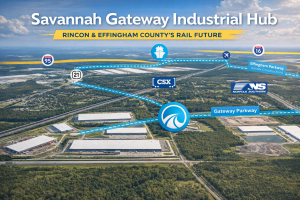
The Savannah Gateway Industrial Hub (SGIH) is a master‑planned, 2,600‑acre multimodal logistics and industrial campus located near Rincon in Effingham County, Georgia. Planned at full build‑out to support more than 18 million square feet of industrial, warehouse, distribution, and light manufacturing space, SGIH is designed to function as a critical inland extension of Port of Savannah operations.
Rather than operating as a single warehouse site, SGIH is structured as a long‑term logistics ecosystem. Building sizes range from approximately 75,000 square feet to more than 2 million square feet, allowing flexibility for global logistics firms, manufacturers, and suppliers at different scales.
At the center of the development is a multi‑phase Megarail rail terminal, purpose‑built to support intermodal freight movement. Phase 1 has already been completed, establishing the foundational rail infrastructure that future phases will expand upon as demand grows.
A key differentiator is that SGIH is rail‑served by both CSX and Norfolk Southern, with on‑site rail switching operations provided by OmniTRAX, a major North American rail and logistics operator. This configuration allows freight to move efficiently from ship to rail to inland markets without relying exclusively on truck transport.
Why Rail Matters More Than Ever in Modern Logistics
To understand why this project matters, it helps to zoom out.
The Port of Savannah has grown into one of the fastest-expanding container ports in North America. As volumes increase, the ability to move cargo inland quickly becomes just as important as unloading ships at the dock.
Rail plays a central role in this equation.
Intermodal rail allows containers to move hundreds of miles inland without relying solely on trucks, reducing congestion near the port and accelerating delivery to inland markets. This is why Georgia Ports Authority invested heavily in Mason Mega Rail at the Garden City Terminal and why inland rail hubs like Savannah Gateway are now essential.
SGIH functions as a pressure-release valve for port growth. It allows freight to move off-terminal and closer to end users, warehouses, and manufacturing centers without bottlenecking Savannah’s road network.
Norfolk Southern and CSX: Why Dual Class I Rail Access Changes Everything
One of the most strategically important features of the Savannah Gateway Industrial Hub is its dual Class I rail access, served by both Norfolk Southern and CSX. Few inland logistics hubs offer this level of redundancy and optionality.
What Dual Rail Access Means in Practice
For shippers and tenants, dual rail service provides:
- Greater routing flexibility based on destination markets
- Competitive shipping rates driven by optional carrier selection
- Reduced risk of disruption from service interruptions
- Faster integration into national and regional distribution networks
On‑site rail switching operations, managed by OmniTRAX, further streamline operations by allowing containers and railcars to be efficiently sorted and staged within the hub itself. This reduces dwell time and improves overall supply‑chain velocity.
From a national logistics standpoint, this dual‑rail configuration connects Effingham County directly into rail corridors serving the Southeast, Midwest, Northeast, and Gulf regions, transforming Rincon from a peripheral location into a functional distribution crossroads.
How the Port of Savannah Feeds the Inland Network
The Savannah Gateway Industrial Hub operates as part of a coordinated freight ecosystem anchored by the Port of Savannah, one of the fastest‑growing container ports in North America.
At the port, containers are transferred directly from vessel to rail through the Mason Mega Rail facility at the Garden City Terminal. This ship‑to‑rail capability significantly reduces cargo dwell time at the port and allows freight to move inland more quickly.
SGIH functions as a downstream staging and distribution point within this system. Located approximately 12 miles from the Port of Savannah, the hub offers a cost‑efficient alternative to on‑terminal warehousing while remaining close enough to maintain fast dray times.
This inland distribution model:
- Reduces truck congestion near the port
- Lowers transportation costs for shippers
- Supports higher cargo volumes without overwhelming coastal infrastructure
- Encourages logistics and manufacturing growth in inland counties
Effingham County’s geographic position makes it a natural beneficiary of this port‑to‑rail strategy.
Proximity to Hyundai Metaplant: A Long‑Term Manufacturing Tie‑In
The Savannah Gateway Industrial Hub’s location also places it within strategic reach of the Hyundai Motor Group Metaplant in Bryan County, one of the most significant manufacturing investments in Georgia’s history.
SGIH is located roughly 15 miles from the Hyundai facility, making it well‑positioned to support:
- Tier 1 and Tier 2 automotive suppliers
- Parts and component distribution centers
- Logistics support operations
- Light manufacturing and assembly uses
Large manufacturing plants rely on complex supply chains that prioritize reliable rail access, available land, and proximity to both ports and highways. Rail‑served hubs like SGIH are often among the first locations evaluated when supplier networks begin expanding.
As Hyundai’s production footprint grows over time, supporting logistics and industrial demand typically follows, creating long‑term synergy between Effingham County, Bryan County, and the Savannah metro region.
Why This Matters for Effingham County Real Estate
Large‑scale logistics and rail infrastructure projects tend to influence real estate gradually at first, then more decisively as employment and investment compound.
Residential Impact
As SGIH attracts logistics, manufacturing, and distribution employers:
- Job growth increases housing demand
- Rental markets often tighten
- New residential development follows established employment corridors
Rincon’s combination of strong schools, manageable commute times, and proximity to Savannah positions it to absorb growth while preserving its small‑town character.
Commercial and Investor Interest
Rail‑served regions frequently draw:
- Warehouse and flex‑space development
- Long‑term industrial investment
- Supporting retail, service, and infrastructure expansion
The Savannah Gateway Industrial Hub already hosts or supports companies such as DHL, Knight‑Swift, Quantix, Kyungshin, Lion Brand Yarns, Aertssen, and Weida Freight System, signaling real‑world adoption rather than speculative planning.
This activity expands the tax base and typically accelerates additional public and private infrastructure investment.
Infrastructure Beyond the Rail: Roads and Connectivity
Rail projects rarely stand alone.
As SGIH expands through future phases, surrounding infrastructure such as Highway 21, Effingham Parkway, McCall Road, and connections toward Port Wentworth and Bloomingdale become increasingly important.
Transportation planning often accelerates around major logistics hubs, improving regional connectivity and supporting both residential and commercial growth.
Why Phase 1 Is Only the Beginning
With Phase 1 completed, the foundation is in place. Future phases are designed to expand capacity, rail length, and operational flexibility as demand grows.
Rail infrastructure is built with decades in mind. Once a hub is established, it anchors economic activity long-term.
Communities that recognize this early are better positioned to make informed decisions about housing, land use, and investment.
Seeing the Project in Real Time
For those interested in the scale and progress of construction, current on-site footage provides valuable perspective. The active build-out highlights the seriousness of the investment and the long-term vision behind it.
This visual context reinforces that the Savannah Gateway Industrial Hub is not speculative. It is happening now.
Final Thoughts: Rincon’s Role in a Much Bigger System
Rincon and Effingham County are not simply growing because Savannah is nearby. They are being intentionally woven into a national distribution network that connects global shipping lanes, Class I railroads, manufacturing centers, and inland markets.
The Savannah Gateway Industrial Hub Megarail project represents a strategic shift. One that elevates the region’s economic relevance while preserving its long-term livability.
For homeowners, buyers, and investors alike, understanding these forces before they fully materialize provides clarity and confidence.
Infrastructure shapes communities quietly at first, then permanently. Rincon is in that early chapter right now
Explore More Effingham County Real Estate
- Rincon GA Real Estate Market Update 2026 — How Megarail-driven growth is reshaping Rincon real estate.
- Effingham County Market Update — March 2026 — Latest market data for Rincon, Springfield, and Guyton.
- Springfield GA Housing Market Update — How Springfield is responding to the Effingham growth corridor.
- Effingham County Market Updates — Monthly data hub for the Effingham corridor.