

Springfield is the Effingham County seat, the most affordable of the county’s three towns, and — right now — the one whose future is most clearly tied to a single piece of infrastructure. A wastewater plant expansion broke ground in May 2026. Until it comes online, almost every new subdivision here is waiting on it. This guide puts real numbers behind what living in Springfield GA looks like in 2026, and explains what actually unlocks the growth everyone keeps predicting.
The Springfield Housing Market Right Now
Here is Springfield (ZIP 31329) across the last four months of reported data, from the same RPR figures behind our monthly Effingham County market updates:
| Month | Median List | Median Sold | Days on Market | Inventory | Homes Sold | Market Type |
|---|---|---|---|---|---|---|
| April 2026 | $335,000 | $352,000 | 78 | 5.89 mo. | 12 | Balanced |
| May 2026 | $349,950 | $278,500 | 67 | 5.60 mo. | 12 | Balanced |
| June 2026 | $358,900 | $339,400 | 47 | 4.90 mo. | 22 | Seller’s |
| July 2026 | $335,239 | $259,000 | 59 | 4.90 mo. | 9 | Seller’s |
Why the Sold Price Swings So Hard Here
Look at that sold column: $352,000, then $278,500, then $339,400, then $259,000. If you took it at face value you would think Springfield lost a third of its value since April.
It didn’t. Look at the last column instead. Springfield closed nine homes in July. Twelve in April. Twelve in May. At that volume the median is not a market indicator — it is a description of which nine houses happened to close. Two modest homes closing in the same month will drag it down $50,000 without a single property in town losing value.
Here is the check that settles it: RPR put the median estimated value in 31329 at $289,810 in July, against a $259,000 median sold. The gap is a mix shift in what sold, not a decline in what homes are worth.
The signals worth watching in a market this thin are the ones that don’t depend on sample size:
- Inventory tightened and held. Springfield went from 5.89 months in April to 4.90 in June and stayed there. Under five months is seller’s-market territory.
- Sellers collected 98.7% of asking in July, against 49 active listings.
- It is the slowest market in the county — 59 days in July against 51 countywide and 39 in Rincon. In Springfield, “priced right” and “sells fast” are not the same sentence they are down Highway 21.
- It is also the most affordable. Median list here runs roughly $50,000 under Rincon and $60,000 under Guyton.
The Growth Switch: Springfield’s Wastewater Plant
This is the part almost nobody outside county government talks about, and it explains more about Springfield’s next five years than any other single fact.
Springfield’s wastewater treatment plant is permitted for 0.6 million gallons a day. Parts of the facility are more than sixty years old and run with limited redundancy, and peak flows have already touched 0.860 MGD — above the permitted average. In practical terms the city has been close to the ceiling for a while.
So the city is rebuilding it. Ground was broken in May 2026, with Ruby-Collins as contractor and Thomas & Hutton as engineer, and construction runs through 2027. The scale shows up in the budget: Springfield’s FY2026 budget jumped to $56.6 million from $11.7 million the year before, and $47.1 million of that sits in the Water and Sewer Fund. This is a small town making a very large bet.
What it buys: the upgraded plant is expected online in late 2027 to 2028 and to support roughly 3,300 additional residential units.
An important clarification, because this gets repeated wrong locally. Springfield has not declared a building moratorium and has not published a numeric cap on sewer connections. What exists is a timing constraint — projects are being approved now with construction schedules that depend on the plant finishing. That is a meaningfully different thing from a freeze, and if someone tells you Springfield is closed for building, they are overstating it.
What’s Already Approved
The clearest example of that timing constraint is also the biggest thing to happen to Springfield’s housing supply in years.
On June 9, 2026, the City Council voted 4–2 to annex and rezone about 116 acres near SR 119 and Wilder Road, roughly a mile west of Highway 21, for up to 310 homes. It is Springfield’s first Planned Unit Development. The plan includes 40- to 80-foot lot widths, fee-simple duplexes, pocket parks, a 50-foot undisturbed perimeter buffer, required sidewalks and street trees, and a GDOT traffic study. Its construction timeline is explicitly tied to the wastewater upgrade.
Springfield also revised its R5 zoning district to allow up to 20% multi-family inside single-family subdivisions, with a 25% open-space requirement — the mechanism that lets townhomes and narrow-lot homes into neighborhoods that would otherwise be detached-only.
For context on why any of this matters: countywide, new home permits have fallen to roughly 288 a year, down from about 576 two years earlier, and there are only about 11 active listings under $250,000 in all of Effingham County. The county projects a need for roughly 5,200 new homes over eight years. Supply is the constraint, and in Springfield the constraint has a completion date.
Living in Springfield GA: The Day-to-Day
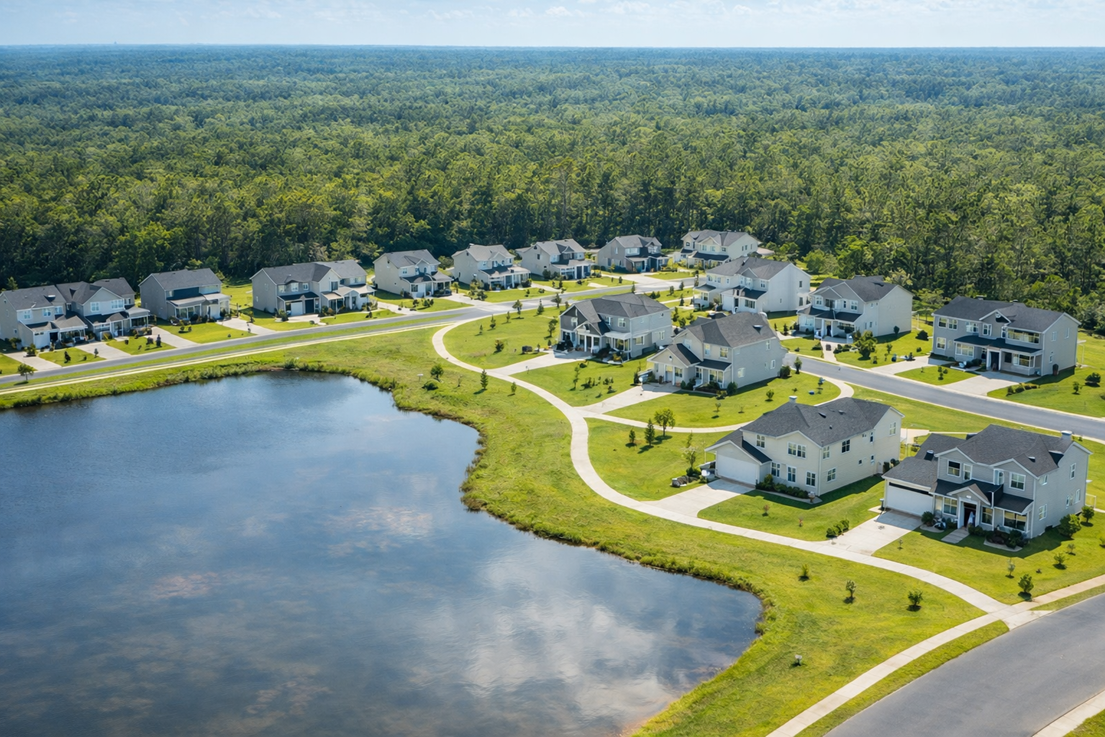
Springfield has been the county seat since the county government moved here in the early 1800s, and it still feels like one. The Old Effingham County Courthouse on North Pine Street, built in 1908–09 and on the National Register since 1980, anchors a downtown of restored historic buildings rather than strip centers.
The Mars Theatre on South Laurel Street, established in 1945 and owned and run by the city, is the genuine center of gravity — concerts, Tuesday and Thursday movie nights, a summer film series, community theater. The Springfield Fall Festival is the biggest day of the year; the 2026 edition lands November 14 with Diamond Rio headlining. First Friday Family Nights run through the warm months with food trucks downtown.
The city is spending on the walkable parts too: Alderman Lane is a new downtown street with added parking, the Mars Theatre is getting roof and foundation repairs plus a bigger lot, sidewalks are going in on First, Madison, Zoller and Laurel, and Ulmer Park got new restroom facilities starting May 2026.
On distance — Springfield sits about 26 miles from Savannah, roughly 23 from Pooler, 22 from the Georgia Ports terminals at Garden City, and only about 8 miles from Rincon. Those are free-flowing estimates, and Highway 21 southbound at 5pm is not free-flowing. The more honest number is the one from the census: Springfield residents report a mean commute of about 25 minutes, because most of them don’t drive to Savannah every day.
Springfield Schools
Springfield is served by the Effingham County School District, and the district has been building.
Effingham County High School is here, on GA Highway 119. In January 2026 it cut the ribbon on a 150,000-square-foot addition — roughly $30 million, ESPLOST-funded, about six years from design to opening — adding an auxiliary gymnasium, an athletic performance center, a science wing, a band room and life-skills classrooms. Enrollment runs around 2,200.
District-wide, Creekside Elementary opens on Blue Jay Road in fall 2026, built specifically to pull pressure off existing elementary schools, and South Effingham High is slated for a comparable expansion to the one Effingham County High just finished.
One thing to confirm before you write an offer: the high-school attendance boundary between Effingham County High here in Springfield and South Effingham High over in Guyton runs through parts of the county, and lines get redrawn as buildings open. Verify the zoning for the specific address at the Effingham County School District site. To compare Effingham against Chatham, Bryan and Bulloch on your own terms, GreatSchools puts the ratings and test scores side by side.
Neighborhoods and What’s Coming
Springfield today is mostly established neighborhoods, older homes near downtown, and county roads with acreage on them — the same unrestricted, no-HOA parcels that are getting scarce everywhere in Effingham. If a shop or room for a trailer is on your list, read our guide to homes with shops in Effingham County before you start looking.
What’s coming is different in kind: the 310-home PUD on the west side, more townhome and narrow-lot product under the revised R5 rules, and whatever follows once the plant is finished. If you are buying here as a long hold, you are buying ahead of that.
If You’re Buying in Springfield
You have more room here than anywhere else in Effingham. Fifty-nine days on market means you can see a house twice before deciding, and 49 active listings against nine monthly closings means a fair number of sellers have been waiting.
Watch the list-versus-sold gap. Median list was $335,239 in July against $259,000 sold — some of that is mix, but some of it is optimistic pricing sitting unsold. Ask how long a listing has been on market before you decide what to offer.
And ignore the monthly median when you value a specific house. At nine sales a month it tells you nothing about your street. Price off comparable homes in comparable condition.
If You’re Selling in Springfield
Sellers collected 98.7% of asking in July — but that figure belongs to homes priced correctly on day one. In the slowest market in the county, an overpriced listing does not get discovered; it gets old.
The competitive picture is about to change. When the wastewater plant comes online and new subdivisions start delivering, existing homes will be competing with new construction that can offer rate buydowns and design-center incentives. If you have been thinking about selling in the next few years, the window before that supply arrives is worth a conversation.
Work With Someone Who Actually Works Here
We publish the Effingham County market updates every month with Rincon, Springfield and Guyton broken out separately — because they are three different markets, and averaging them together hides exactly the kind of thing this page is about.
The neighboring guides cover living in Rincon, GA and living in Guyton, GA — three different markets inside one county.
When you want a straight answer about a specific street, a specific school zone, or what your own home would actually sell for, get in touch.
Market figures reflect RPR data through July 2026 for ZIP 31329. Wastewater, zoning, development and school details reflect reporting and city records as of August 2026 and remain subject to change; this page is updated as they do. Population and commute figures are estimates from public sources.