


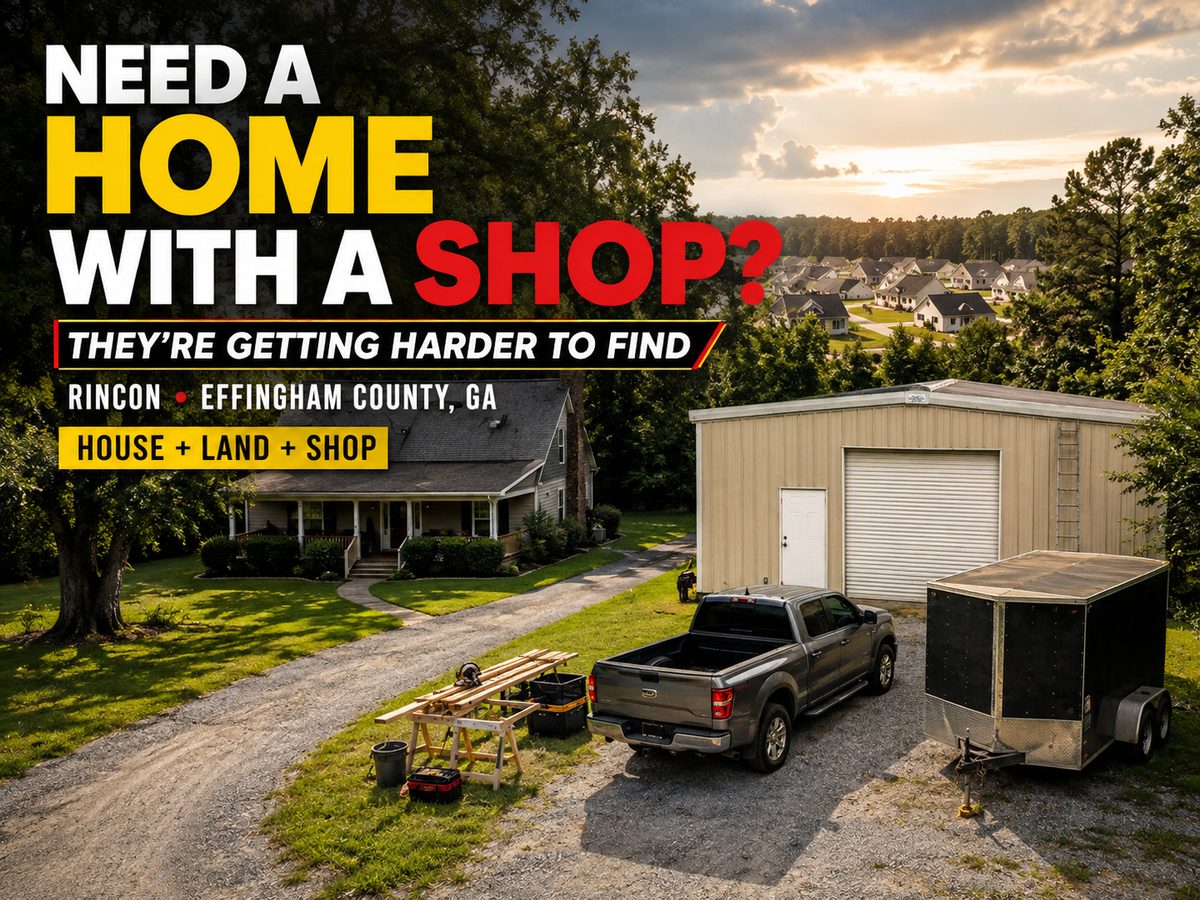
Almost every week I get a version of the same call: “I need a house, but I really need somewhere to put the truck, the trailer, and the tools.” Sometimes it’s a contractor. Sometimes it’s a woodworker, a mechanic, a car guy, or somebody whose hobby quietly turned into a business. The house part is negotiable. The shop part is not — and homes with shops in Effingham County are getting harder to find every year.
Here’s the honest picture: why they’re scarce, what it actually costs to build one if you can’t find one, what to look at before you fall in love with a property, and where they still turn up.
Why Homes With Shops in Effingham County Are Hard to Find
Effingham has been one of the fastest-growing counties in coastal Georgia, and nearly all of that growth has come in the form of subdivisions. A new build in Rincon or Springfield typically sits on a quarter acre or less, inside a covenanted neighborhood, with a two-car garage and an HOA. That’s a good product for a lot of buyers. It is a terrible product for anyone who needs a shop.
The properties that work are almost always older homes on unrestricted land — places built in the 1960s through the 1990s, before the parcel got swallowed by a subdivision plat. Those are a finite supply, and every year a few more of them get bought, subdivided, or torn down. That’s the whole story: demand for shop space keeps going up while the inventory that can accommodate it goes down.
What It Actually Costs to Build One
Buyers often tell me they’ll just buy the acreage and put a shop up later. Sometimes that works. But price the whole job before you count on it.
I’ve said in the past that the building is the cheap part and the site work is what gets you. That’s not quite right, and it’s worth correcting. The shell is the biggest single line item. But the site work is the part nobody budgets for, and it’s what turns a $50,000 project into a $70,000 one.
Start with the building. National 2026 cost data puts a detached garage or shop at roughly $40 to $70 per square foot all-in — detached costs more than attached because it needs its own foundation, its own roof, and its own utility runs. For a 40×30 building, the size of the workshop at 193 Grace Lane, that’s about 1,200 square feet, or $48,000 to $84,000. A metal or steel shell comes in well under a stick-built one — figure $15 to $35 per square foot on the exterior versus $40 to $70 — which is exactly why most of the shops you see around here are steel.
Then add the site work, which is where the surprises live:
| Line item | 2026 range | For a 40×30 (1,200 sq ft) |
|---|---|---|
| Grading and site prep | $0.40–$2.00 / sq ft | $480 – $2,400 |
| 6-inch concrete slab | $8–$10 / sq ft | $9,600 – $12,000 |
| Underground electric run + interior wiring | $10–$25 / linear ft | $1,200 – $7,100 |
| Subpanel | — | $500 – $1,700 |
| Electrical permit + inspection | — | $150 – $550 |
| Gravel pad or driveway extension (~500 sq ft) | $4–$10 / sq ft | $2,000 – $5,000 |
| Site work subtotal | $13,930 – $28,750 |
A few notes on that table. Go with a 6-inch slab, not 4-inch, if a truck, a lift, or heavy equipment is ever going on it — the thinner pour is about $2 a foot cheaper and it will crack under load. Running power overhead is roughly half the cost of burying it, but most jurisdictions require burial to a detached structure, so budget for the trench. And the gravel line is the one people forget entirely: a shop you can’t back a trailer into is a very expensive storage shed.
Put it together and building a 1,200-square-foot shop from scratch realistically lands somewhere around $62,000 to $110,000, before the county’s building permit fee and before anything unusual on your particular site.
Those are national 2026 cost ranges, not quotes from a Rincon contractor — treat them as a sanity check, not a bid. Get real local numbers before you plan around any of it. Effingham County publishes its actual permit fee schedule, and that’s the number to use rather than an estimate.
Which brings me to the point of all this: an existing shop that is already permitted, already powered, already sitting on a slab that’s proven it drains represents somewhere north of $60,000 of work you don’t have to do, on a timeline of zero. That’s not a bonus feature buried in the listing remarks. That’s a substantial share of the property’s value.
Zoning, Covenants, and the HOA Problem
Three separate things can stop you from using a shop the way you want, and they’re easy to confuse.
Zoning is the county’s rule. Much of rural Effingham carries an agricultural-residential designation such as AR-1 or AR-2, which is generally friendly to outbuildings and to keeping equipment on site. Some parcels also sit inside the county’s Commercial Corridor Overlay, which can open up future flexibility along the main routes. Zoning is public record — verify the specific parcel with Effingham County before you make a plan around it.
Covenants are private restrictions recorded against the land itself. A property can be zoned perfectly and still have a covenant prohibiting metal buildings, or limiting outbuilding size, or banning commercial vehicles. Covenants survive the sale and they are not always obvious. Ask for them in writing.
An HOA is a third layer with its own architectural review, and it is usually the one that kills a shop plan outright. This is the single biggest reason “no HOA” shows up in the listing description of nearly every property that works for this buyer.
When a property is described as having no HOA and no covenants, that combination is the actual asset. It’s rarer than it sounds.
Well, Septic, and What Else Comes With Acreage
Most unrestricted acreage in Effingham is on a private well and a septic tank. That’s normal here and nothing to be scared of, but it changes your due diligence.
Get the septic system inspected and pumped, and find out where the drain field runs — you cannot pave or build over it, which sometimes dictates where a shop or an addition can go. Have the well water tested, and ask about the pump’s age and depth. Budget for the fact that a well pump or a drain field is a replacement cost that shows up all at once rather than a monthly bill.
The trade in your favor: no water bill, no sewer bill, and no HOA dues. Over the life of a mortgage that’s real money back.
Where These Properties Actually Turn Up
Look along the older county roads rather than inside the newer neighborhoods. In the Rincon area that means the roads running off Highway 21 — Fort Howard Road and the lanes coming off it, Old Augusta Road, and the stretches toward Ebenezer. Springfield and Guyton have their own pockets of one- to five-acre parcels with outbuildings already standing.
The practical advantage of Effingham over a further-out county is that you can have the land and still commute. Savannah, Gulfstream, the Georgia Ports terminals, and the Highway 21 industrial corridor are all inside a reasonable drive, and the Hyundai Metaplant corridor over in Bryan County pulled a lot of new demand into the whole region. You’re not trading your job for the acreage. For more on how the area is changing, see our guide to living in Rincon, GA.
What to Ask Before You Write an Offer
On any property with an outbuilding, get answers to these before you’re under contract:
- Was the shop permitted, and is there a certificate of occupancy or final inspection on file?
- What wind load was it engineered and anchored for, and is there documentation? This is coastal Georgia — it matters for the building and for your insurance.
- What’s the electrical service — amperage, and is it 240V if you need it?
- Is there a concrete slab under the whole footprint, and how thick?
- What’s the door opening height and width? A roll-up door that won’t clear a trailer is a problem you can’t fix cheaply.
- Does the roof or the site drain properly? Ask to see it after a hard rain if you can.
- Are there covenants recorded against the parcel, and what do they say about outbuildings and commercial use?
- What is the parcel zoned, and does the intended use match?
- Will your insurer cover the outbuilding, and at what replacement value?
What’s Available Right Now
I currently have one that fits this profile almost exactly: 193 Grace Lane in Rincon — a 4-bedroom, 2-bath Cape Cod on 1.63 acres with no HOA and no covenants, and a detached 40×30 steel workshop with a roll-up door, roughly 1,200 square feet. It’s on well and septic, zoned AR-2, and sits inside the Commercial Corridor Overlay. There’s a full video tour and a 3D walkthrough on the listing page.
Inventory like that moves, so if you’re reading this later and it’s gone, the same search still applies — I keep an eye on this specific niche across all four counties I work.
Thinking About Selling a Property With a Shop?
If you own one of these, understand what you have. Run the numbers above in reverse: a buyer looking at your property is looking at $60,000-plus and a year of permitting and construction they get to skip. A well-built outbuilding on unrestricted acreage draws a completely different buyer than a comparable house in a subdivision — and that buyer is often less price-sensitive, because there is no substitute for what you’re selling. The shop should be marketed as a headline feature, not buried in the last line of the remarks.
You can start with a home value estimate, or look through Rincon homes for sale and the Effingham County market updates to see what’s actually moving. For county zoning, permitting, and the current fee schedule, Effingham County’s website is the authority — always confirm parcel-specific rules there before you plan around them.